Norway’s Fjords: The Cliff’s Edge and the Seven Sisters
You're standing on the edge of a cliff, with 604 metres of empty space and dark water beneath your feet. No guardrails. Just you and the fjord.
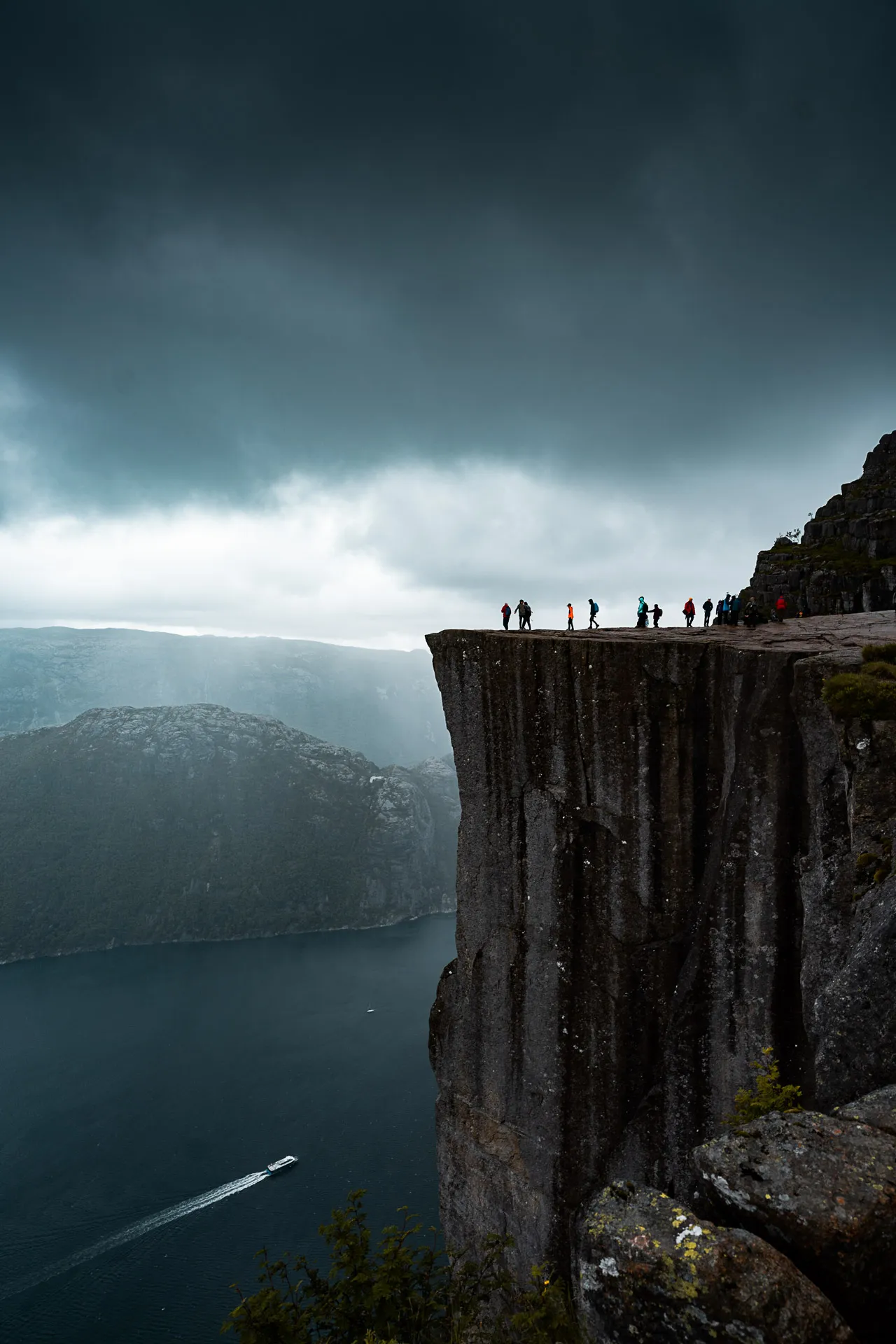
You are standing on a flat rock the size of a football pitch, and beneath your feet, 604 metres of empty space simply disappear. No fence, no safety net. Just the edge, the wind, and the Lysefjord flowing like a dark ribbon far below. This is Preikestolen, "The Pulpit", and when you finally reach this spot after a two-hour climb, your body refuses to step forward. Your brain knows it's safe. Your instinct doesn't buy it.
Norway is a place where geology isn't an abstract textbook concept, but something you see, touch, and hear. The fjords were carved by glaciers over ten thousand years ago, and they still carry the scars of that colossal force. Mountains rise straight out of the sea, without warning, without suburbs. And between them winds water so still that it reflects the peaks like a perfect mirror.
Preikestolen: two hours up, a lifetime in the memory
The trail to Preikestolen starts gently, winding through birch forests and past mountain lakes. Then it gets real. You climb stone steps laid by Sherpas, navigating sections where thousands of boots have polished the rock smooth. Around you, travellers from all over the world pant their way up, while kids somehow overtake everyone. And then the trees disappear, the plateau opens up, and there it is: a sheer square of rock hanging over nothingness, with the fjord curving away to the horizon behind it.
You sit on the edge, dangle your legs over the abyss if your nerve holds out, and just stare. Far below, a boat cuts through the water looking like a tiny white dot. The sheer scale of it shrinks you, and that is exactly the feeling you came for.
Geiranger: the seven sisters falling from the sky
Further north lies another face of the Norwegian fjords. The Geirangerfjord has been on the UNESCO World Heritage list since 2005, and the moment you lay eyes on it, you understand why. Fifteen kilometres of dark water squeezed between cliffs over a thousand metres high, capped with snow even in mid-summer. Waterfalls with names straight out of legend cascade down the rock faces: "The Seven Sisters" tumble in seven separate streams, while "The Suitor" faces them from the opposite bank. Legend has it he keeps trying to woo them, but the water never stops flowing, and he never succeeds.
You get the best view from the water. A small boat takes you deep into the fjord, the walls rise high on both sides, and the acoustic shifts—everything falls silent except for the distant roar of the falls. Perched on the cliff edges, in seemingly impossible locations, sit abandoned farms. People actually lived up there, cut off from the world, raising goats on slopes you wouldn't dare look down today.
The journey is half the adventure
Winding between the fjords is the Trollstigen (The Troll's Road), a hairpin sequence of eleven sharp bends climbing a vertical mountain wall. As you drive up, the Stigfossen waterfall crashes right across the road, and from the top, the entire route lies beneath you like a crumpled ribbon. There is rarely a dull kilometre in Norway. The landscape changes with every single bend, and just when you think you've seen the absolute best, the next turn proves you wrong.
The train that drops from the clouds
There is another way to enter the fjord besides water and your own two feet. The Flåm Railway plunges from the barren mountain plateau down to sea level in less than an hour, along one of the steepest standard-gauge tracks in the world. The train crawls past vertical cliffs, negotiates hand-carved tunnels, and pauses at the Kjosfossen waterfall, where the water thunders down just metres from your window. At the bottom, the Nærøyfjord awaits—the narrowest fjord in Europe and another UNESCO treasure. In some places, the cliffs crowd so close that the sun only reaches the water for a few hours a day. Sailing through this crack in the mountains, the silence is so heavy you can hear your own breath. Scale and intimacy all at once: a mountain massive beyond belief, and a boat small as a walnut shell right in its heart.
When to go
The best time to explore the fjords is from late May to September, when the mountain passes are open, the waterfalls are swollen with melting snow, and daylight stretches almost to midnight. June and July bring the longest days and lush green slopes. Early autumn offers fewer crowds and a crisp, sharp light. Pack a rain jacket no matter what—the weather here changes its mood in minutes.
Norway doesn't shout. It just stands there, vast and quiet, waiting for you to find it. And when you sit on the edge of Preikestolen and finally stop talking, you realise that some places don't need any words at all.
Author: Martin Bonov