Wild Faroe Islands: What Lies Ahead
In the Faroe Islands, the animals don't hide. Sheep stand right on the road, holding your gaze. Puffins land just meters away. Seals bob their heads above the water, watching you with an inquisitive, almost polite curiosity. Out here, wildlife isn't something you go looking for. It's a world you simply step into.
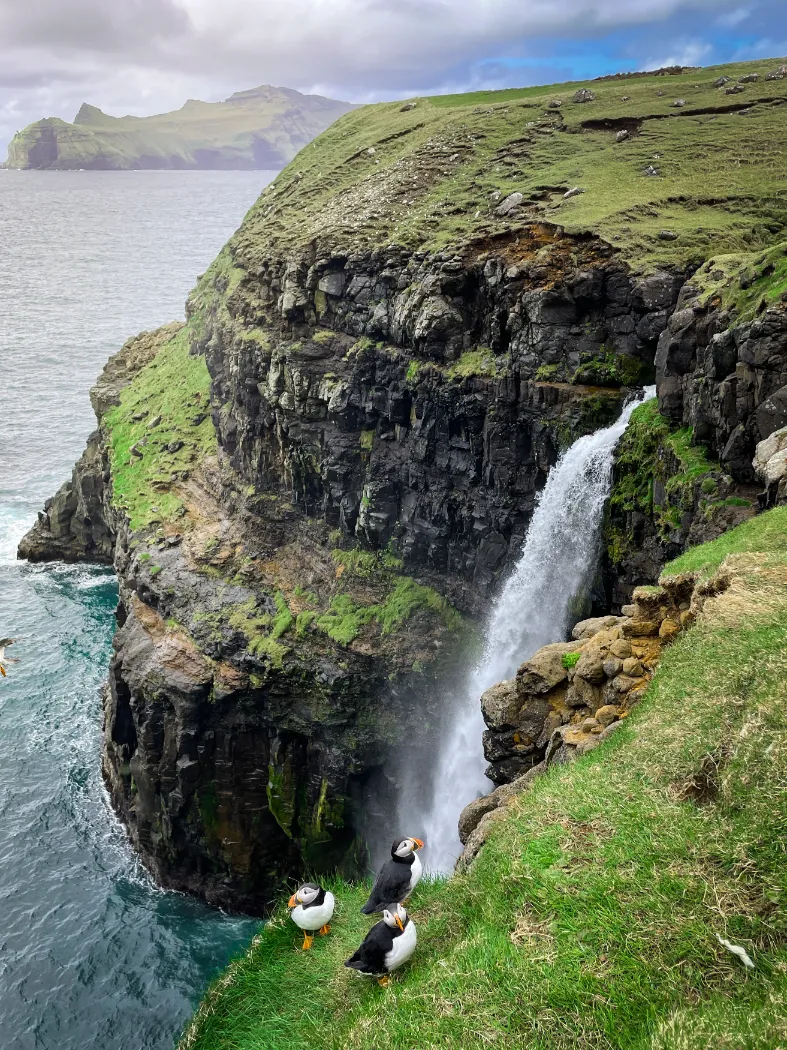
At first glance, the Faroe Islands seem barren. No trees, no forests, no visible movement except the grass bending under the wind. But beneath this apparent emptiness lies an ecosystem shaped entirely by the ocean. Cold Atlantic currents bring nutrients that lure fish. The fish bring birds. The birds draw predators. And above it all, 80,000 sheep—outnumbering the human population—graze on slopes so steep they look impossible to climb.
The wildlife here isn't diverse in a tropical sense. You won't find dozens of mammal species, nor reptiles, nor amphibians. But what does exist here is concentrated, visible, and so close you can hear it breathe.
The birds: millions claiming the cliffs
The Faroes host over 300 bird species, but it's the sheer scale of the nesting colonies that blows you away. Hundreds of thousands of seabird pairs nest on the cliffs every summer. Storm petrels, northern gannets, guillemots, gulls, fulmars, and oystercatchers.
The bird cliffs of Vestmanna are one of the most accessible spectacles. A boat brings you right up to sheer cliffs rising hundreds of metres high, with birds clinging to every single ledge. The noise is constant: shrieks, the beating of wings, the crashing water. As the boat sways and the cliffs tower above, birds circle at every level, from the water to the peak. It’s a vertical world on a scale you rarely experience.
Gannets are the most striking: large, white, with a wingspan reaching 1.8 metres. They dive-bomb into the ocean, hitting the water like arrows and emerging with fish. It’s a hypnotic, endless loop. Every dive is flawless, as if rehearsed thousands of times. Because it has been.
Puffins: the face of the islands
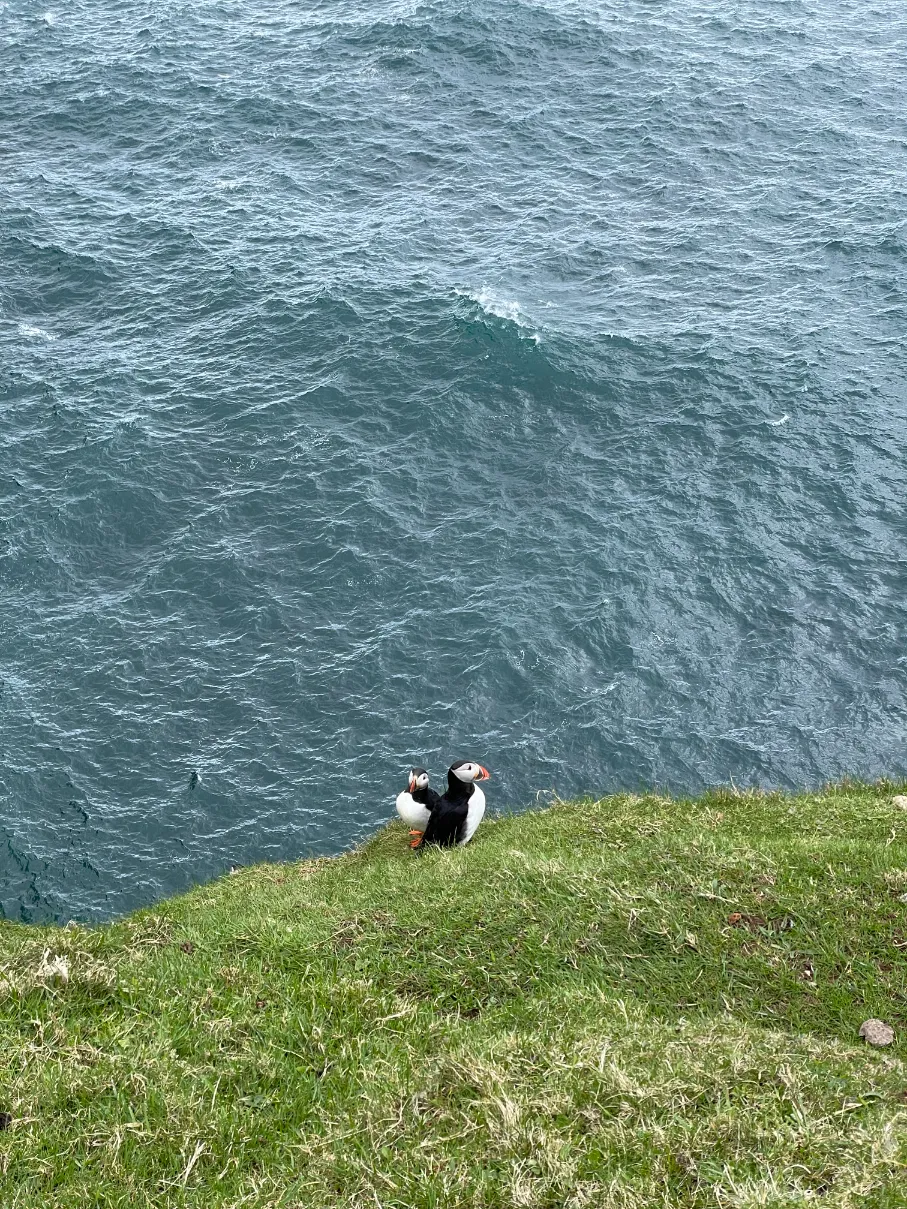
The Atlantic puffin is the unofficial emblem of the Faroe Islands. A small, colourful bird with an orange beak and black-and-white feathers, it looks like a cross between a penguin and a parrot. Puffins arrive on the islands from April to August to nest. The rest of the year, they live in the open ocean, flying for hours without once touching land.
Mykines island is home to the most famous colony. Accessible by ferry (weather permitting), the trail to the colony winds through grassy slopes where puffins literally stand at your feet. They don't run. They aren't scared. They just stare at you with those small, serious eyes, then turn back to whatever they were doing.
But puffins also have a darker story in the Faroes—they are a traditional delicacy. Puffin hunting has been part of Faroese culture for centuries and is still permitted, even as their numbers decline. It’s a complex, emotional topic with no easy answers. On the islands, it’s a reality of daily life, not a tourist attraction.
Seals: the silent observers
Two species of seals inhabit the waters around the Faroe Islands: the grey seal and the common seal. Both are relatively common, especially in the quieter bays and around the smaller, uninhabited islands.
Encountering a seal in the Faroes isn't an organized event. It just happens. You drive along a fjord, stop, look at the water, and spot a head. Round, smooth, with big, dark eyes looking back at you with what can only be described as curiosity. Inspecting you, just as you inspect it. Then, with a quiet splash, it dives and vanishes. No promises, no guarantees. Just a raw, spontaneous moment.
Around Mykines and the northern coasts, you might spot them hauled out on the rocks in small groups. Lazy, calm, and absolutely indifferent to your presence, as long as you keep your distance. In a place with so few people and such cold water, the seals are used to being left in peace.
Sheep: the true owners
80,000 sheep to 54,000 humans. The math is simple: the sheep rule here. They are everywhere—on the slopes, along the roads, on the rooftops (yes, literally on turf roofs when the grass grows low enough). They aren't afraid of cars, couldn't care less about humans, and always have the right of way.
Faroese sheep are a hardy breed adapted to the islands over centuries. Smaller than continental sheep, with thicker wool to withstand the wind and cold, they graze on slopes that a human would struggle to scale. Sometimes you see them on the edge of a cliff, hundreds of metres above the roaring ocean, completely unfazed, as if gravity were optional.
The very name
Author: Martin Bonov
Other articles about Faroe Islands